RBC Avion Rewards Platform & Payments
Opening Avion to non-bank members meant building money movement customers never had to think about.
Built for financial scale
5M+
settlement events annually
A centralized settlement capability kept cashback withdrawals reliable across validation, money movement, state tracking, and exceptions.
Platform details have been simplified to protect confidential financial and technical information.
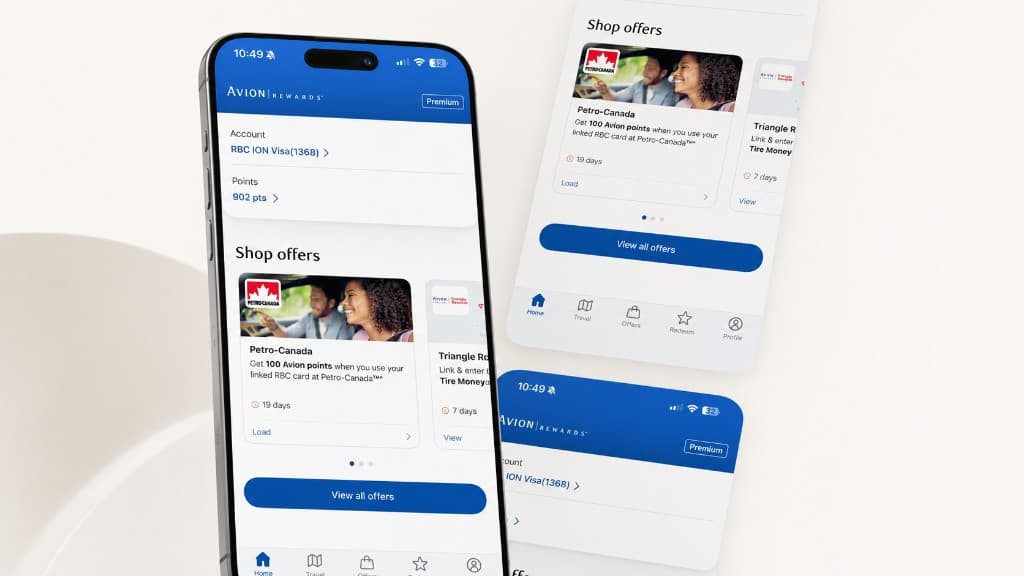
Overview
Avion wanted to open rewards to Canadians without an RBC banking relationship. On paper that is a growth story.
In practice it meant building identity, settlement, and servicing for money movement behind an experience that still had to feel as simple as checking a balance.
As Senior Product Manager for Core Experiences, I owned the web and mobile surfaces, self-service cashback withdrawal, and the settlement infrastructure underneath.
Member-to-settlement architecture
Customer experience
Platform flow
Supporting capabilities
The opportunity
Traditional Avion members arrived with RBC identity and account context. New members did not.
That shifted the product problem:
- Secure onboarding without existing online banking credentials
- Cashback balances and withdrawals without an RBC deposit account
- Reliable money movement with fraud, risk, and compliance constraints
- Consistent web and mobile experiences on top of legacy dependencies
Success was not enrollment alone. Members had to reach value: earn, see balance, withdraw, receive funds.
From bank-dependent rewards to a broader consumer platform
Before
- Existing RBC relationship
- Existing authentication
- Existing deposit account
- Established customer identity
- Bank-linked redemption paths
After: new capabilities required
- Independent registration
- Secure sign-on
- Avion member account
- Cashback balance
- External withdrawal destination
- Settlement and transaction tracking
- Customer support states
My approach
1.Followed the full value journey
We mapped Discover → Join → Authenticate → Earn → Withdraw → Receive funds so the team did not optimize registration while leaving barriers between signup and realized value.
Enrollment was the beginning, not the outcome
- 01
Discover
Learn about Avion
Acquisition surfaces
Risk: Low intent
- 02
Join
Create an Avion account
Registration and identity
Risk: Identity mismatch
- 03
Authenticate
Access the platform
Secure sign-on
Risk: Auth failure
- 04
Earn
Accumulate rewards
Rewards and earning rules
Risk: Eligibility gaps
- 05
View balance
See available cashback
Balance and ledger visibility
Risk: Stale balance
- 06
Withdraw
Access earned cashback
Validation, limits, settlement
Risk: Invalid destination
- 07
Receive funds
Complete transfer
Settlement and status tracking
Risk: Processing failure
2.Treated withdrawal as a financial product
The UI was three steps. Behind it: eligibility, thresholds, settlement initiation, pending and failed states, ledger records, reconciliation, and servicing visibility, aligned with engineering, finance operations, risk, and legal.
Designing the self-service cashback experience
View available balance
Current amount · Pending transactions · Balance accuracy
Enter withdrawal amount
Minimum threshold · Maximum threshold · Available-balance validation
Confirm destination and details
Authentication · Destination validation · Duplicate prevention
Track processing status
Settlement initiation · Pending status · Exception handling
Receive confirmation
Transaction confirmation · Updated balance · Customer record
3.Built settlement once, not per feature
A centralized capability handled validation, money movement, state tracking, and exceptions so customer channels stayed simple as volume grew.
4.Instrumented activation, not just traffic
Measurement covered enrollment completion, withdrawal success, failure modes, latency, and release health, not page views alone.
What shipped
Self-service cashback withdrawal
Eligible non-RBC members could withdraw earned cashback to an external financial institution, with balance visibility, eligibility checks, confirmation, and clear status when something failed.
Settlement infrastructure
The platform processed more than five million settlement events annually at approximately 99.9% uptime. That was the invisible layer that made the simple withdrawal flow trustworthy.
Before: fragmented processing
- Repeated validation logic
- Inconsistent transaction states
- Difficult reconciliation
- Tight coupling between interface and processing
After: centralized settlement capability
Reusable financial infrastructure connecting customer products to downstream processing, not an isolated withdrawal feature.
Avion Select foundations
Secure access, onboarding, and core digital experiences supported 250K+ new member sign-ups during the growth period. I owned the digital and platform pieces, not the full program.
Core web and mobile
Foundational experiences other Avion teams depended on, plus acquisition tools like ShopPlus that extended how members discovered and used the program.
The platform behind self-service cashback
Experience layer
Product-service layer
Financial-platform layer
Enterprise ecosystem
Simplified capability model. Financial, security, and technical implementation details have been generalized.
Impact
The through-line was consumer simplicity backed by regulated infrastructure that stayed reliable when customers moved real money.
5M+
Automated settlement events supported annually
~99.9%
Platform uptime
$15M+
Annualized cashback withdrawals through the digital experience
0-to-1
Self-service cashback withdrawal capability
Customer access
Enabled eligible members without a traditional RBC deposit account to access earned cashback.
Platform leverage
Created reusable settlement and digital capabilities rather than an isolated withdrawal feature.
Operational confidence
Supported transaction tracking, reconciliation, exception handling, and production reliability.
Growth enablement
Provided secure access, onboarding, and digital foundations supporting expansion beyond existing RBC customers.
What I learned
What I took from building financial products at consumer scale:
Consumer simplicity requires platform complexity
The most effective financial experiences make difficult processes feel straightforward across identity, settlement, reconciliation, and servicing.
Growth does not end at enrollment
Activation determines whether potential value is realized, from registration through earning, accessing, and withdrawing rewards.
Money movement requires explicit state design
Pending, failed, delayed, duplicate, and exception states need deliberate product design, not afterthoughts.
Platform products serve operational users too
Finance operations, servicing, risk, and compliance depend on the same platform the customer sees.
Reliability is part of the customer proposition
When a product manages customer funds, uptime and transaction accuracy are essential to trust.
Instrumentation should reflect the value chain
The most useful measurement connected acquisition, activation, transaction completion, reliability, and financial outcomes.
Continue reading

01
Arc'teryx Membership & Customer Engagement Platform
Connecting guest relationships across retail, digital, and service without defaulting to another points program.
02
Arc'teryx Transactional CRM Infrastructure
When a shipment email fails, customers do not blame the template. They blame the brand.
04
Aeroplan Co-Brand Cards & Digital Growth
Co-brand card growth across three issuers: one customer journey, many partner handoffs.